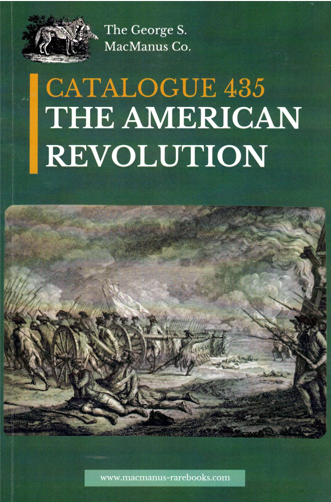
The George S. MacManus Co. has published a catalogue of The American Revolution. What can be said of the American Revolution? A lot. Here are 100 books that tell much of the story. Many of the items are contemporary, giving views as the war proceeded and opinions after its conclusion. Some pertain to events leading up to the momentous event. The Revolution, naturally, had a huge impact on America, and a lot, but not quite as much, on Britain. Now, 250 years later, we see its lasting impact on the whole world as the new nation then created has become the most powerful one on earth. Imperfect, yes, but the good certainly outweighs the bad. Others who sought that position included some very bad players. Here are a few selections from this catalogue.
We begin with a sermon delivered ten years before the Declaration of Independence and the start of the American Revolution. The speaker was Pastor Edward Barnard of the First Church of Haverhill. It is a warning that recent events could lead to a calamity – a revolution. That, in turn, could result in a government elected by a popular vote. Barnard saw this as a negative. He wrote, “a government altogether popular is slow, uneven, and liable to convulsions, and subversion.” His concerns were not unreasonable. He wanted a government “economically independent, educated, leisured order of society standing securely and permanently above petty selfishness of ordinary men scattered through half a continent.” The title is A Sermon Preached before his Excellency Francis Bernard, Esq; Governor and Commander in Chief, The Honourable His Majesty's Council, And the Honourable House of Representatives, Of the Province of the Massachusetts-Bay in New-England, May 28th, 1766. Being the Anniversary for the Election of His Majesty's Council for said Province. Petty selfishness surely is a problem with elected officials, but that and much worse often comes from governments not accountable to their constituents. Item 2. Priced at $500.
The Declaration was not well-received in all quarters of Britain. One such person was attorney John Lind, who wrote a scathing response, An Answer to the Declaration of the American Congress. This is a 1776 fifth edition of a pamphlet obviously well-read in the old country. Lind defends King George, saying the dispute is not between the benevolent King and his subjects but between some of his subjects and others, those being their representatives in Parliament. He explains that the King had nothing to gain, that more taxation on the Americans or less would make no difference to him personally. Leave the King out of this. Lind then proceeds to rebut 28 objections to the actions of the Crown. He claims, “Happy should I be, were it possible to induce this deluded people to listen to the voice of reason; to abandon a set of men who are making them stilts to their own private ambition, to return to their former confidence in the King and Parliament...” His happiness was denied. Item 39. $1,750.
Not all Englishmen were so contemptuous of their unhappy American brethren. Richard Price was a British minister and one such subject who let his opinions be known in his pamphlet Observations on the Nature of Civil Liberty, the Principles of Government, and the Justice and Policy of the War in America. This is one of two first American editions, published in 1776, just days before the Declaration of Independence was promulgated. Price communicated with the likes of Washington, Adams, Jefferson, Paine, and Franklin. He strongly supported the Americans' objection to British taxation. His opinions are believed to have encouraged his friends to go forward with their Declaration. Price was offered honorary American citizenship, but declined. One place where he would later disagree with the new American government was on the issue of slavery, taking the Declaration's “all men are created equal” more seriously than did the founders. Item 454. $4,500.
Joseph Galloway was a major figure in pre-Revolutionary Pennsylvania. Close friends with Franklin, he served 18 years in the Pennsylvania Assembly, from 1756-1774. As a member of the First Continental Congress, he devised something of a compromise proposal to growing antagonism between Britain and its colonies. It called for a union between Britain and the colonies. It wasn't adopted. Galloway became increasingly upset with the Congress becoming more radical. He opposed the Declaration of Independence, and three months later fled to British controlled New York. He provided intelligence to the British, and when they took control of Philadelphia, he was appointed Superintendent of the Port and of the Police. When the British abandoned Philadelphia, he again fled, this time to England, never to return. While still seeking to find a compromise, Galloway wrote, A Candid Examination of the Mutual Claims of Great Britain, and the Colonies: with a Plan of Accommodation, on Constitutional Principles, published in 1775. Item 35. $7,500.
We conclude with a last look at those who participated in the Revolution...literally. It was published in 1864, while the descendants of those who fought in the Revolution were locked in an internecine battle north and south. Rev. Elias Hillard tried to rekindle that patriotic camaraderie in the midst of that terrible struggle. He tracked down every still-living survivor of the Revolutionary War, photographed them, and provided biographical sketches. He was able to find six, whom he photographed, and believed there was a seventh as there was no record he died, though he could not be located. The book is The Last Men of the Revolution, Together with Views of Their Homes Printed in Colors. Accompanied by Brief Biographical Sketches of the Men. The six photographs are mounted. The men were Samuel Downing, Daniel Waldo, Lemuel Cook, Alexander Millener, William Hutchings, and Adam Link, while James Barham was not photographed. None of these men had long to go. The last of them, Lemuel Cook, died two years later at the age of 107. Daniel Bakeman was the last surviving pensioned veteran of the Revolution when he died in 1869 aged 109, though some have questioned whether his pension claim was accurate. If not, then Cook may have been the last survivor. Item 61. $8,500.

Lemuel Cook, possibly last survivor of the Revolution
The George S. MacManus Co. may be reached at 610-520-7273 or books@macmanus-rarebooks.com. Their website is www.macmanus-rarebooks.com