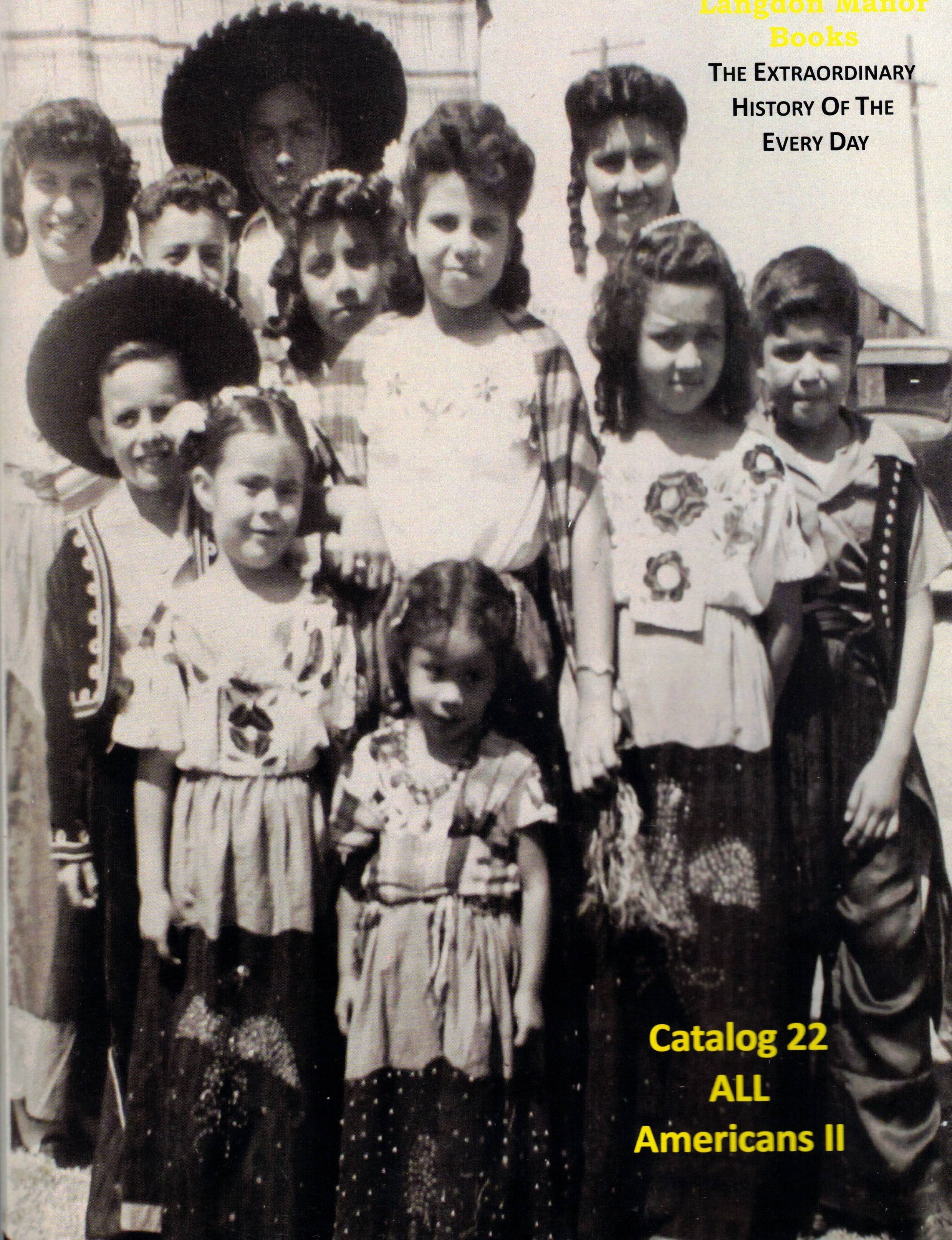
Langdon Manor Books has released their latest selection of various sorts of material, Catalog 22 ALL Americans II. There aren't a lot of printed books here, but many personal items such as photographs, commonplace books, and many others. When they talk about “All” Americans, they mean a diversity of races, ethnicities, and interests. “Diversity” has become something of a dirty word to many, but there is nothing more American than diversity, the melting pot that created one nation. Here are a few selections.
Richard Simmons had a large following on television. A flamboyant weight loss and fitness trainer, he had people who needed to lose a few pounds dancing and exercising all over America. Simmons had a weight problem himself when younger, but lost half of that weight through exercise. He was not just a run-of-the-mill exercise guru but an effective motivator. He took his motivation, and some acting roles, to TV. He may have been seen everywhere during his career, but in 2014, he essentially disappeared from public view, living his final ten years mostly in semi-seclusion. Item 9 is a personal photo album Simmons compiled between 2009-2013, ending shortly before his retirement. Most were taken at Simmons' Gym, many with happy clients at holiday and birthday parties. Many have him in outlandish dress, part of his flamboyant personality. Some images have motivational comments and before and after pictures of clients, with Simmons' handwritten comments. He had no children which explains why such a personal album ended up in his estate auction. Priced at $500.
What better gift could you give your son, at least if you were living in the pre-Civil War South, than a large group of slaves? Item 5 is a Deed of Gift for Enslaved Persons, circa 1859. Perhaps William Fleming of North Carolina figured he wouldn't be able to possess them much longer anyway. He gave them “in consideration of the natural love and affection which I have unto my son John,” plus “the sum of one dollar to me.” He gave John “all of the following,” which included Benjamin, Mary, “and her three children viz Polley Amandy and Pompey...and all their increase.” That “increase” included some of the eight more slaves John received, who soon would be freed. $500.
Next is a commonplace book from 1860-1861. It contains 92 locks of hair, each identified with a first and last name. They are held in place with colorful pieces of fabric. The most common names are Christy, Oles, Bashear and Bowers. No location is given but one person was from Chester County, Pennsylvania, and two were from a Columbia. There is a Columbia in a county adjacent to Chester in Pennsylvania, so that is a likely location. A little research should show whether those families lived in the general area around 1860, maybe still do. This would be quite a find for one of them. Item 20. $650.
In the late 19th century, the U.S. Government, not knowing what to do with its native population that stubbornly clung to its ways, opened Indian schools, designed to assimilate their children into American culture. Children were taken to boarding schools where they would learn trades and become Americanized. One such school was the Chilocco Indian school in Oklahoma. It opened in 1884 with 150 students from various western tribes. Item 41 is A Souvenir Book of Photographic Views of the Chilocco Indian Training School. An Institution Supported by the U.S. Government for the Education of Indian Boys and Girls, from 1906. By this time, the book said it had around 700 students from 40 different tribes. It was one of the first five off-reservation boarding schools created by the government. The school emphasized training for trades such as “blacksmithing, horseshoeing, wagon making, carpentry and cabinet making, printing, tailoring...also the domestic arts such as dressmaking, baking, sewing, cooking, housekeeping, laundering and nursing.” The 58 photographs show the print shop and schoolrooms, with shots of students in the band, an art class, cultivating cabbage, farming, playing on the football team. Buildings shown include the gym, pump house, slaughter house and hospital. They also show the vineyard, apple orchard, and quarry. The number of students continued to grow until the 1950s, but as local schools opened to Indian students, enrollment declined. It was down to around 100 students when the school closed in 1980 after the government discontinued funding. Item 41. $1,500.
The heyday of patent medicines produced cures that would put today's medicine to shame. The nice thing about these cures is they often cured everything, rather than having to take many different medicines for each ailment. Not all cures of the day came in pill bottles. There were also devices. Here is one that was popular in the late 19th early 20th century. It was known as an electric belt. You would wear and it would pulse a low electrical current into your body. Electricity was still something of a miracle back then, such electrical devices as bringing light (light bulbs) and sound (radios), miracles in their own right. Thomas Edison wasn't involved with this particular electronic device, but Dr. A. Owen was. The Owen Electric Belt and Appliance Co. offered one in 1893. This ad was aimed at the German-American community as it is written in German, but the belt was equally ineffective no matter what language you spoke. It is a 40-page promotional brochure with a picture of Dr. Owen on the cover. He had a thick, heavy beard and an absence of scruples. He claimed it cured all sorts of maladies with testimonials from satisfied dupes. One says “acute rheumatism, indigestion, and liver abscess cured.” Dr. Joseph Messert, “the well-known and celebrated physician and expert in chronic diseases,” said “they work like magic.” You can still buy electric belts today, but these are the kind of belts electricians use to carry their tools, not to cure their ailments. Item 22. 200.
Langdon Manor Books may be reached at 713-443-4697 or Orders@Langdonmanorbooks.com. Their website is found at www.LangdonManorBooks.com.