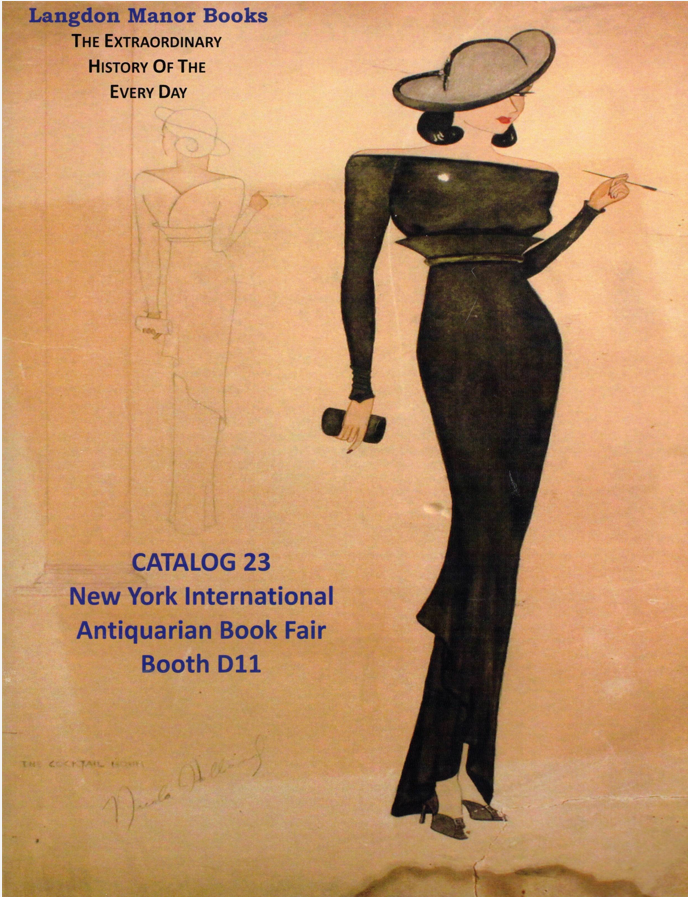
Langdon Manor Books is offering their Catalog 23, prepared for the recent New York Antiquarian Book Fair. “Books” may be in their name but there aren't a lot of those. This is mostly first person material. Many are personal accounts, documents, photographs, art work, travelogues, and such. These are one-of-a-kind items that give a look inside the lives of people who lived either a while or a long time ago. This is fascinating material. Here are some samples.
We start with a supplier of suits and various other items. The selection was large and they had numerous distributors. Nonetheless, it lasted only a little over a decade. It's name is reminiscent of a completely different product – Crack-a-Jack. I don't know if they were playing on the name of the well-known candy popcorn and peanuts product (Cracker Jack) or just focusing on the aspect of speed, crackajack being an expression meaning fast. They didn't include a free toy with their suits. Item 35 is a salesman's book with swatch samples of the products. It contained 312 samples. Along with suits, Crack-a-Jack sold overcoats, collars, cuffs, belts, hats, and more. The brand was owned by Danforth Mills, about whom I can find nothing. Crack-a-Jack provided custom tailoring, “with all the mind consolation and body-comfort that go with clothes you get from a high priced tailor, but you don't have to pay the excessive tax.” They guaranteed a fit or no sale. Perhaps that's what they were referring to with the odd “mind consolation” claim. It appears that they started around 1907 and the teens were their heyday. Langdon Manor was unable to find any references to the company past 1920, so it presumably ceased business around that time. Priced at $1,750.
Next is the United States Department of the Interior Annual Report, Division of Extension and Industry: Rosebud Jurisdiction, Rosebud Reservation and Yankton Sub Agency. This report is from 1936. Conditions were never easy for Indians forced from their land to smaller and smaller reservations. However, this was a particularly hard time. It was the midst of the Dust Bowl era, winds blowing across the South Dakota plains. The report describes attempts to reclaim the barren land in this time of ecological disaster. They did manage to put up 12,017 tons of hay and took in $45,240 from livestock products. Unfortunately, “farm crops were almost a total failure.” The Commissioner of Indian Affairs encouraged improved changes in agricultural processes and elevating younger tribal members into leadership roles over their elders. The report contains 54 pages of narrative text, 42 pages of forms, and 307 photographs. All have typed captions. It explains, “All in all the extension workers aim is to 'Help the Indians Help Themselves.'” Item 57. $12,500.
Item 17 is a scrapbook with 66 original photographs and 186 pieces of ephemera. The title is My Trip Abroad, kept by Violet M. Warrington. She was part of a group of African Americans who accompanied Adolph “Dolly” Hodge, a Black school teacher who was the tour operator, in 1933. They visited Holland, France, Italy, Germany, Switzerland and Belgium. Hodge would lead more tours in the future, taking trips to Mexico during the war years. In America, accommodations for Black people were hard to find outside of places that catered specifically to African Americans. In Europe, they were accepted almost everywhere. She writes, “the single hotel on the Continent that did not accept the party was in Venice. The proprietor of that hotel replied that his clientele was white Americans, mostly old maids – the inference being that they would object to their Colored Countrymen.” She also notes, “Most of the other passengers are foreigners and their attitude is not to regard their Colored fellow passengers as some race apart, like the Americans on board.” Ms. Warrington concludes, “I shall not be satisfied until I go again!” Item 17. $4,000.
On April 27, 1958, Vice-President Richard Nixon undertook a “goodwill” tour of Latin America. There was some discontent among the peoples in the various countries. Dictatorships, some brutal, were common in those days, and students in particular expressed opposition, even if often muted out of necessity. America was not seen as a friend. It was deep into the Cold War then and the U.S. supported just about any government it perceived as anti-communist, no matter how poorly it treated its own people. Nixon's longest stop was in Argentina to attend the inauguration of a new president. His next stop was Paraguay. It was run by a brutal, corrupt dictator, Alfredo Stroessner. Nonetheless, this and Nixon's other early stops went well, with nothing more than minor demonstrations. Some students shouted “long live liberty” during demonstrations, which Stroessner brushed aside by claiming it was a communist slogan. He knew the magic word to keep Nixon on his side. Living in Paraguay at the time was Otto Lins-Morstadt, German silent film actor and director who had emigrated to the country after the Second World War. He brought his camera along and took photos. There are around 16 of them, four including Nixon. Other pictures come from around the country. His photo album includes a typed and signed thank you note from Nixon, presumably for sending him these pictures. The rest of Nixon's tour did not go quite so well. Angry demonstrators in Peru threw rocks at him. In Venezuela, while his car was stuck in a traffic jam, demonstrators attacked, almost overturning the car. His safety was in doubt until the traffic jam broke and he was able to escape. The demonstrators wanted the U.S. to support democracy in Latin America through more than lip-service, and wanted aid for their terrible economic plight, rather than just support for anti-communism. Nixon brought back the message and some policy adjustments were made, but the Cold War focus remained America's priority. As for Paraguayan dictator Stroessner, he managed to remain in power despite the calls for democracy until 1988, when he was overthrown by a military coup. Item 61. $850.
This is another photo album, older, with stark and gritty images of wartime. It was a professionally assembled album created by the British Expeditionary Force in France during World War I. The photographer appears to be a member of the Tank Corps. There are 108 photographs, all but four 6” x 8”. The pictures are all captioned. Photos are from the Somme area of France and Flanders. There are numerous photographs of destruction, including destroyed churches and piles of rubble. Soldiers are seen in trenches, digging, cooking, clearing debris and taking positions. Others are seen clearing roads, moving and firing howitzers. One shows prisoners of war marching alongside a trench. Another picture shows a tank with the caption, “one of the first tanks.” It is dated September 15, 1916, which is known to be the first day tanks were used in combat. Item 73. $5,000.
Langdon Manor Books may be reached at 713-443-4697 or Orders@Langdonmanorbooks.com. Their website is found at www.LangdonManorBooks.com.